

What is the mulesing method?
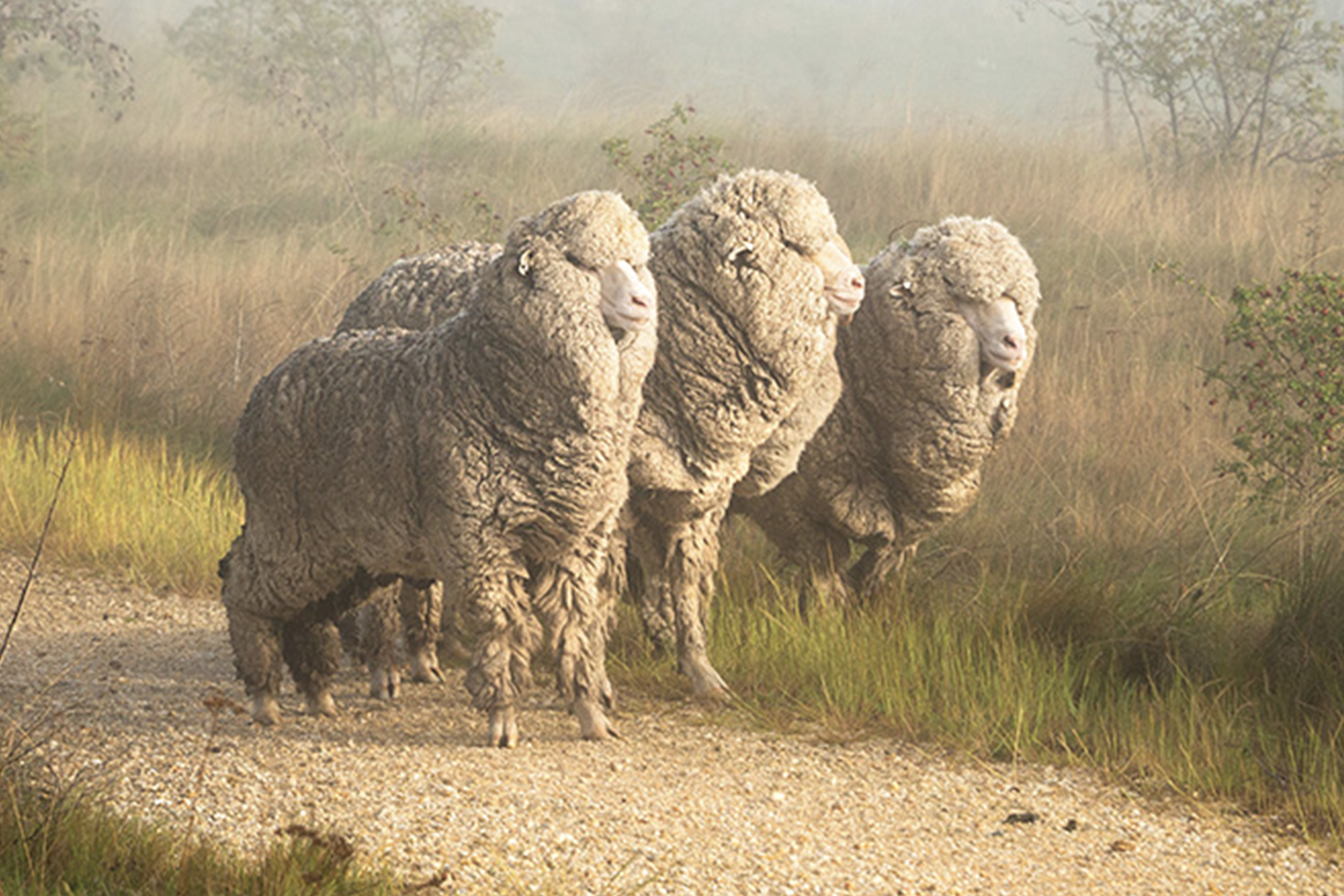
The merino wool used in ENGEL products is mulesing-free and comes from certified organic livestock farming (kbT) in South America. The merino wool used in ENGEL products is mulesing-free and comes from certified organic livestock farming in South America. The mulesing method is a practice common in Australia and New Zealand to prevent fly strike – known as myiasis – in merino sheep. Merino sheep with thick wool folds around the anus and genitals are particularly affected. Certain species of blowflies find ideal conditions for laying eggs in these areas: warmth, moisture, poor ventilation and contamination from faeces and urine.
The hatched larvae eat into the skin and subcutaneous tissue and can seriously injure or kill the animal. To prevent this, some farms practise mulesing – a painful, invasive procedure in which lambs have skin folds around their anus, vulva and tail removed without anaesthesia.
These wounds heal without treatment, leaving scarred, smooth skin on which no wool grows, thereby reducing the risk of fly infestation. It is mainly used because it is quick and cheap, not because it is the best method of controlling fly larvae infestation.
Is mulesing the same as crutching?
The term ‘crutching’ is sometimes used synonymously with mulesing, but in sheep farming it originally describes the shearing of wool around the anal areato prevent contamination.
Unlike crutching, mulesing is a surgical procedure in which skin is cut away rather than simply shorn. It is significantly more invasive, bloody and associated with greater animal suffering – especially because it is usually performed without anaesthesia.
Is mulesing banned?
Mulesing is not banned worldwide.
In Australia, the world's largest exporter of merino wool, mulesing is still permitted – even on farms with certified organic animal husbandry. Although the NASAA (National Association of Sustainable Agriculture Australia Ltd.) regulates husbandry standards as an organic certification body, the Australian Organic Standard also allows exceptions for mulesing under certain conditions.
The situation is different in other countries, such as Argentina, where climatic conditions mean that there is no infestation of blow flies because these flies do not exist there in the first place, so the question of mulesing is not even necessary.
What alternatives are there to mulesing?
Since years, there are attempts in Australia to replace or avoid the mulesing method. Possible approaches include:
- Breeding Merino sheep with smoother skin that is less susceptible to fly infestation.
- Improved hygiene measures in animal husbandry.
- Medicinal or mechanical treatments to keep flies away.
- Use of insecticides, although these are often harmful to the environment and health and are therefore not permitted in organic farming.
Unfortunately, however, these alternatives are only slowly gaining acceptance – partly due to economic interests in mass production. More than 3,000 wool farmers in Australia are now certified as producers of wool without lamb mutilation (quote: ‘Highlights from agriculture: The future is free of lamb mutilation’ / source: vier-pfoten.ch 21.05.2024).
Is organic virgin wool from certified organic animal husbandry mulesing-free?
Not automatically. Even wool from certified organic animal husbandry can come from sheep that have been mulesed in countries such as Australia or New Zealand, depending on the interpretation of the respective organic certification body.
A guarantee for mulesing-free origin can only be provided by a transparent supply chain and a conscious decision to source from regions where mulesing is not necessary – such as Patagonia in South America.
ENGEL: 100% mulesing-free wool – out of conviction for animal welfare
At ENGEL, we exclusively use organic virgin wool from certified organic animal husbandry in South America (Patagonia). In this region, there is no occurrence of the blowfly that would make mulesing necessary. Due to the climatic conditions – cold, windy air, extreme temperature differences – the virgin wool of the sheep there is more crimped and protects the animals naturally.
A majority of ENGEL wool products carry the ‘NATURTEXTIL – IVN CERTIFIED BEST’ quality label – known to be one of the world's strictest ecological textile certifications.
- Wool from certified organic animal husbandry
- Mulesing-free origin
- Responsible and accountable production conditions
So, you can be sure: Wool from ENGEL is guaranteed mulesing-free.
You may also be interested in:


