
What is mulberry silk?
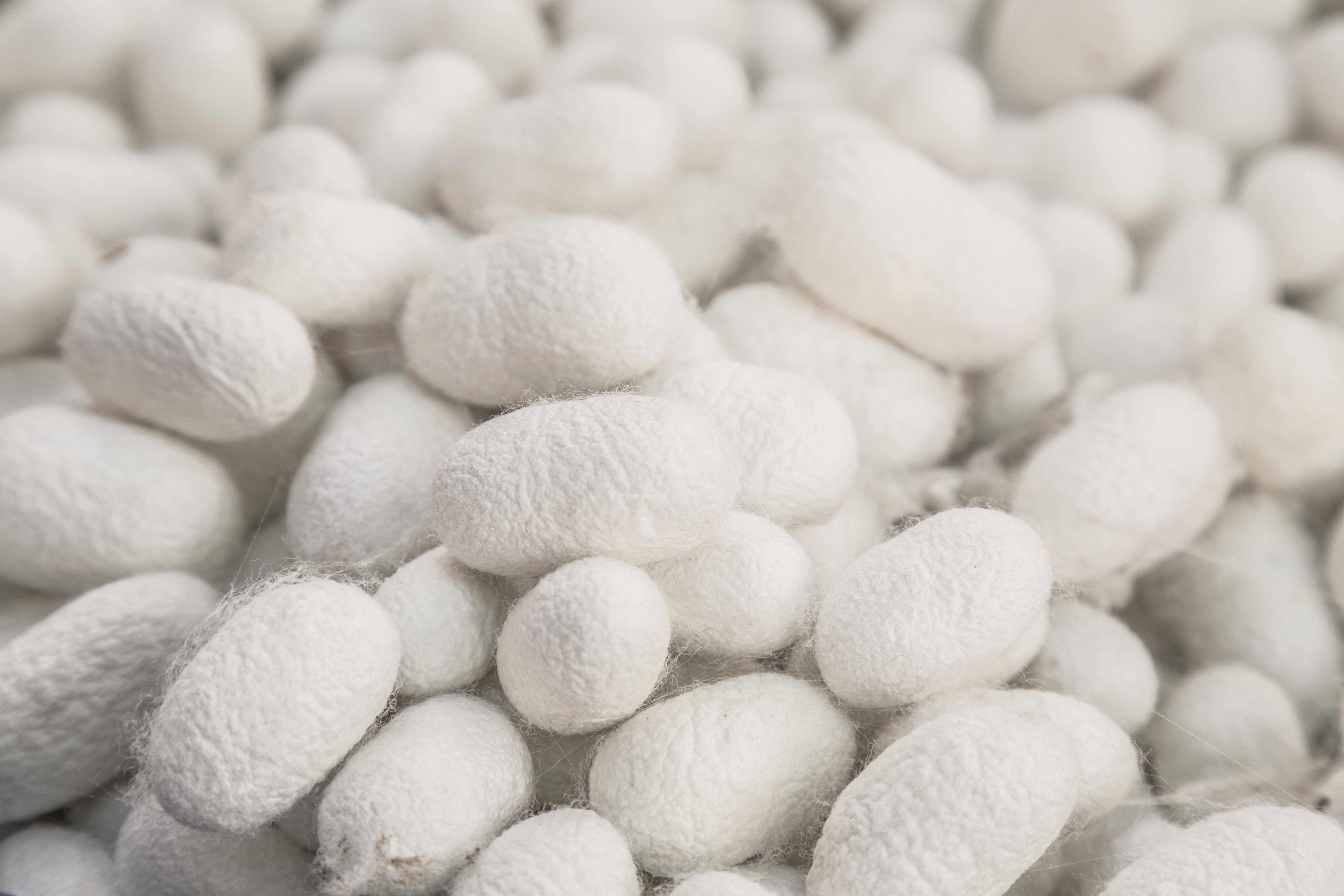
Mulberry silk is considered the finest, purest and highest quality type of silk in the world. It is obtained from the cocoons of silkworms that are fed exclusively on mulberry leaves. This explains the name ‘mulberry silk’.
At ENGEL, we specifically use this high-quality natural fibre to make our wool/silk garments particularly skin-friendly, temperature-regulating, durable and pleasantly soft.
In this article, you will learn
- where mulberry silk comes from,
- how it is produced,
- what distinguishes it from other types of silk,
- why we at ENGEL rely on it,
- and why silk nodules are not a quality defect, but a natural feature of silk processing.
Is mulberry silk real silk?
Yes. Mulberry silk is real silk and is even considered the finest form of silk production. Unlike ‘wild silk’, it comes from the cultivated silkworm species Bombyx mori, which is fed exclusively on the leaves of the white mulberry tree. This controlled diet and rearing ensure:
- a particularly uniform fibre structure,
- high lustre,
- and exceptional tear resistance.
Like all real silk, mulberry silk consists of pure protein filaments produced by the animal itself. The fibres are extremely fine and soft – yet surprisingly strong.
How is mulberry silk obtained?
The production of mulberry silk is a complex and delicate process. It begins with the breeding of the silkworm, which spins its cocoon in a protected, warm environment. This cocoon consists of a single silk thread – up to 3,000 metres long.
This is how mulberry silk is obtained:
- Feeding with mulberry leaves – for pure, uniform fibre quality
- Cocoon formation – the silkworm pupates over several days
- Heating – prevents hatching and preserves the thread structure*
- Reeling off the thread – the silk thread is wound up and then processed
The process requires a great deal of manual labour, experience and precision. This is why mulberry silk is one of the most expensive natural fibres in the world.
*A study of the Cambridge University suggests that insects such as the silkworm, probably do not experience the sensation of pain. Nevertheless, we always strive to find new ways that guarantees the well-being of the silkworm.
Is mulberry silk high quality?
Yes. Mulberry silk is considered the highest quality silk. Its fibres are special:
- fine (approx. 11 micrometres) – significantly finer than human hair
- supple and shiny
- tear-resistant and durable
- temperature-regulating – cooling in hot weather, warming in cold weather
- skin-friendly and anti-allergenic – ideal for sensitive skin and babies
These properties make mulberry silk perfect for combining with virgin wool – as in our popular wool/silk products from ENGEL.
Where does mulberry silk come from?
Mulberry silk originally comes from China, where silk farming began over 5,000 years ago. Even today, China is still one of the most important producing countries worldwide. Other important countries of origin are:
- India
- Thailand
- Usbekistan
At ENGEL, we pay attention to transparent supply chains, socially responsible manufacturing processes and the highest quality in every fibre when selecting our silk.
What is so special about mulberry silk?
In addition to its unique fibre structure, mulberry silk has the following properties:
- Moisture-regulating – absorbs sweat without feeling wet
- Odourless – antibacterial effect ensures freshness
- Natürlich glänzend ohne chemische Ausrüstung
- Biologisch abbaubar
What are silk nodules?
The processing of silk is very elaborate, and its natural properties, especially its fineness and smoothness, mean that small fiber knots (slubs) can form during the manufacturing process. These knots cannot be removed, or can only be removed with great difficulty, and therefore remain in the garment. Since silk is a pure natural product whose characteristics are highly influenced by environmental factors, the number of these knots can vary.
Silk slubs are therefore not a defect in quality. At ENGEL, we use only mulberry silk of top quality, ensuring that our wool-silk garments are especially soft, skin-friendly, and durable.
What is the difference between mulberry silk and normal silk?
The term normal silk is not clear-cut. It usually refers to ‘wild silk’ – for example, tussah silk. This comes from wild silkworms, whose cocoons are later collected. The threads are often:
- shorter,
- not as fine,
- less shiny,
- and more iregular in colour.
Mulberry silk, on the other hand, is uniformly white, particularly fine and tear-resistant. It is specifically used for high-quality clothing.
Conclusion: Mulberry silk at ENGEL – natural quality with high standards
Mulberry silk is one of the finest fibres that nature has to offer.
At ENGEL, we combine this exquisite silk with virgin wool from certified organic animal husbandry to create clothing that feels light, is functionally impressive and is responsibly produced.
Whether for babies, children, women oder men: anyone with sensitive skin or who values sustainable natural clothing will appreciate the quality of our wool/silk products.


